


Table of Contents
- What Makes Soursop Organic and Why It Matters
- Soursop Leaf Tea Benefits: What the Research Shows
- How to Prepare Soursop Leaves for Tea and Extracts
- Organic Soursop Side Effects and Who Should Avoid It
- Liquid Drops vs. Dried Leaves: Which Form Fits Your Routine
- How to Judge Quality Before You Buy Organic Soursop
- Frequently Asked Questions
Last Updated: September 13, 2026
What Makes Soursop Organic and Why It Matters
Organic soursop is the fruit, leaf, and extract of Annona muricata, grown and processed without synthetic pesticides, synthetic fertilizers, or sewage sludge, and handled under a certified organic system. The distinction matters because you are often consuming the leaf, not just the fruit, and leaves concentrate whatever the plant was sprayed with.
This guide from Planet iZM walks through what the organic label actually guarantees, how to prepare the leaves, what the research does and does not support, and who should be cautious.
Soursop goes by several names. In Latin America it is guanábana, and the leaves are sold as hojas de guanabana. In Brazil and parts of the supplement trade it is graviola. All three refer to the same tree. The fruit is a spiky green superfruit with white, fibrous flesh; the leaves are long, glossy, and dark green, and they are the part most often dried, steeped, or extracted.
Organic certification is not a marketing adjective. In the United States, the USDA National Organic Program sets the production, handling, and labeling standards that a farm must meet before it can print the USDA Organic seal on a package. A product labeled "100% organic" must contain only organically produced ingredients; "organic" means at least 95% organic ingredients; "made with organic ingredients" means at least 70% (ams.usda.gov). Anything below 70% cannot carry the seal at all.
USDA Certified Organic vs. Wildcrafted
These two terms get used interchangeably in wellness marketing. They are not the same thing.
USDA Certified Organic means a USDA-accredited certifying agent has inspected the operation, reviewed the farm's inputs and records, and confirmed compliance with the National Organic Program. The certification is annual and can be suspended.
Wildcrafted means the plant was harvested from the wild rather than cultivated. A wildcrafted soursop leaf is not automatically organic. Wild land can sit downwind of a conventional farm, near a roadside, or on ground with a history of spraying. No certifier verified anything.
Here is the practical upshot:
| Attribute | USDA Certified Organic | Wildcrafted |
|---|---|---|
| Third-party inspection | Yes, annual | No |
| Input records required | Yes | No |
| Pesticide residue testing | Part of the audit trail | Not verified |
| Traceable to a farm | Yes | Often not |
| Can legally use the organic seal | Yes | No |
Neither category is inherently unsafe. But if your reason for buying organic soursop is to avoid agricultural residues, only the certified path gives you a paper trail. "Wildcrafted" tells you where the plant grew, not what landed on it.
Soursop Leaf Tea Benefits: What the Research Shows
Soursop leaf tea is an infusion made by steeping dried soursop leaves in hot water. It is the most traditional preparation, and it is also where the gap between laboratory research and human evidence is widest.
Most of the published work on Annona muricata has been done in cell cultures and animal models, not in controlled human trials. That research has focused on a class of compounds called acetogenins, along with a broader set of phytochemicals found in the leaf. The findings are interesting. They are not the same as proof that drinking the tea produces a specific health outcome in people.
A common mistake is reading a cell-study headline as a clinical result. A petri dish is not a person. Absorption, dosage, and metabolism all change the picture, and none of that has been settled for soursop leaf in humans.
What you can reasonably say is this: soursop leaf contains antioxidants and other plant compounds, and traditional systems of medicine have used it for relaxation and general wellness for a long time. What you cannot say is that it treats, prevents, or cures any disease. Any product that makes that claim is overstepping what the evidence supports.
Antioxidants and Cellular Health
Antioxidants are compounds that neutralize free radicals, the unstable molecules that can damage cells over time. Soursop leaf contains several, which is the basis for most of its wellness positioning.
Cellular health is the frame supplement marketers use for this idea: support the cell, and the rest follows. It is a reasonable way to describe antioxidant activity, and it is also vague enough to mean almost anything. Be skeptical of any label that leans on "cellular health" without naming the specific compounds involved.
The honest position is that antioxidant-rich plant foods fit into a generally healthy diet, and soursop leaf is one of many. It is not a substitute for medical care.
How to Prepare Soursop Leaves for Tea and Extracts
Preparing soursop leaves takes about 15 minutes and needs no special equipment. The variables that matter are water temperature, steeping time, and how coarsely the leaf is cut.
- Start with dried leaves. Fresh leaves hold more moisture and give an inconsistent brew. Dried leaves are more stable and easier to portion.
- Measure one to two teaspoons of coarse-cut dried leaf per cup of water. Coarse cut releases flavor more slowly than a fine powder and is harder to over-steep.
- Heat water to just below a boil, roughly 200°F. A rolling boil can make the infusion bitter.
- Pour over the leaves and cover the cup. Covering keeps the volatile compounds in the steam rather than in the air.
- Steep for 10 to 15 minutes. Longer steeping pulls out more of the bitter notes without adding much benefit.
- Strain and drink. Discard the spent leaves.
For a stronger infusion, some people simmer the leaves gently for 15 to 20 minutes instead of steeping. This produces a darker, more astringent tea.
Preparing a liquid extract at home is a different process and much harder to standardize. You cannot reliably control concentration without measuring equipment, which is one reason commercial liquid drops exist. If you want a consistent dose, a measured liquid format removes the guesswork. Planet iZM's 10-in-1 Soursop Graviola Liquid Drops are built around that idea: a concentrated 60ml bottle with a stated serving size rather than a scoop-and-hope routine.
STAY LOCKED IN WITH PLANET iZM →

Organic Soursop Side Effects and Who Should Avoid It
Organic soursop side effects are the part of this topic that gets the least attention, and it deserves more. "Organic" describes how the plant was grown. It says nothing about how the plant interacts with your body or your medications.
The most-discussed concern involves long-term, high-dose consumption of soursop preparations and a possible association with atypical Parkinsonism. That association comes from epidemiological observations in populations with heavy habitual consumption, not from controlled trials, and it is not the same as a proven cause-and-effect link for occasional tea drinking. It is still a reason to treat concentrated, daily, high-dose use differently from an occasional cup.
Groups who should be cautious or avoid soursop leaf products include:
- People taking blood pressure medication, blood thinners, or diabetes medication
- Anyone taking sedatives or drugs that affect the central nervous system
- Pregnant and breastfeeding women
- People scheduled for surgery within two weeks
- Anyone with a diagnosed neurological condition
This is not a complete list, and it is not medical advice. If you take prescription medication, ask a pharmacist or physician before adding any soursop product to your routine.
Medication Interactions and Daily Limits
There is no officially established daily limit for soursop leaf in the United States, and no regulatory body has set a reference intake (ods.od.nih.gov). Anyone quoting a precise milligram ceiling is inventing it.
What you can do is apply ordinary caution. Start with a single serving, observe how you feel, and do not stack multiple soursop products on the same day. If you are already taking a liquid extract, do not also drink several cups of strong leaf tea.
Liquid Drops vs. Dried Leaves: Which Form Fits Your Routine
Liquid drops win on consistency and convenience; dried leaves win on cost per serving and tradition. The right pick depends on whether you want a repeatable dose or a ritual.
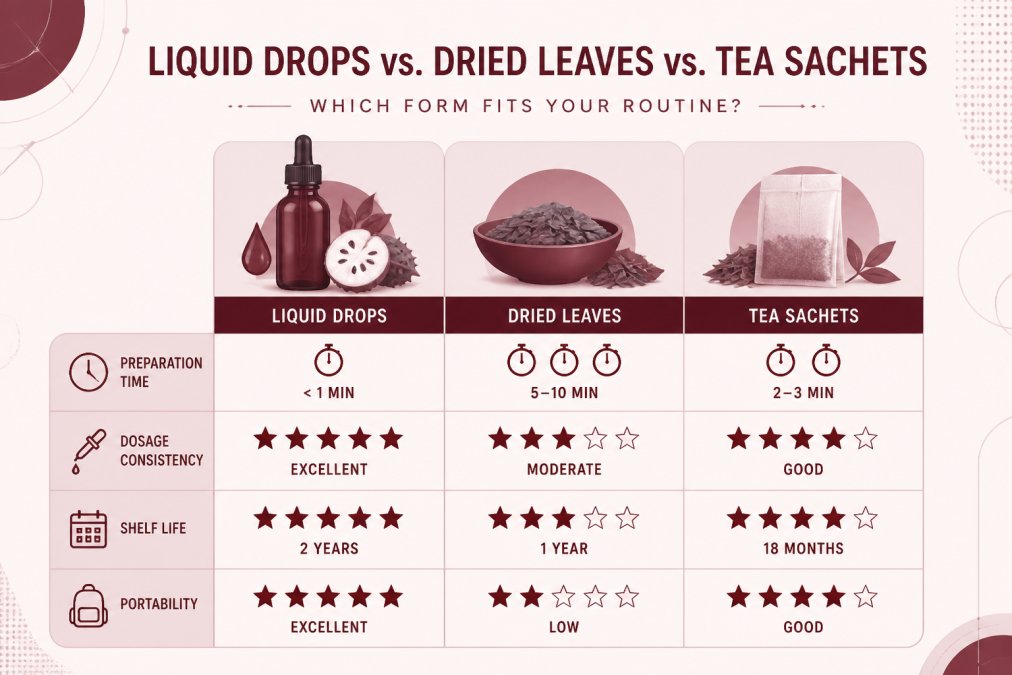
| Format | Prep Time | Dosage Consistency | Shelf Life | Best For |
|---|---|---|---|---|
| Liquid drops | Under 1 minute | High, measured serving | Long, sealed bottle | Daily routines, travel |
| Dried leaves | 10-15 minutes | Low, varies by steep | Long if kept dry | Traditional tea drinkers |
| Tea sachets | 5 minutes | Moderate, pre-portioned | Long, individually sealed | Convenience without measuring |
Liquid drops are the better fit if you travel, work long hours, or simply will not steep leaves every morning. Dried leaves make more sense if you enjoy the preparation and want the lowest cost per cup. Sachets sit in the middle: pre-portioned, fast, and easier to keep in a desk drawer.
The one drawback of liquid drops is that a poorly made product can hide behind a proprietary blend. Read the label for a stated serving size and a clear ingredient list before you commit.
How to Judge Quality Before You Buy Organic Soursop
Quality comes down to four checkable things: the certification, the origin, the cut, and the label. Run every product through them before you buy.
- Does the package carry the USDA Organic seal, and can the seller name the certifying agent?
- Is the country or region of origin stated, and is it a single origin rather than a blend of unnamed sources?
- Are the leaves coarse cut rather than powdered, or is the liquid a measured serving rather than a "proprietary blend"?
- Does the label state non-GMO, gluten-free, and vegan status if those matter to you?
- Is there a lot number or harvest date, or at least a clear expiration date?
- For liquids: is the serving size in milliliters or drops, and is the bottle sealed?
Single-origin matters more than most buyers realize. A blend of leaves from multiple unnamed farms makes traceability impossible, and traceability is the entire point of paying for organic soursop in the first place.
Sustainable farming practices and ethical harvesting are worth asking about too, though they are harder to verify from a label alone. A seller who can describe the farm and the harvest is a better bet than one who cannot.
For a liquid option that states its concentration and serving size up front, Planet iZM's 10-in-1 Soursop Graviola Liquid Drops are worth a look. The 60ml bottle carries a two-year shelf life and a blend format designed for daily use rather than occasional brewing.
Sorting real organic soursop from repackaged marketing claims takes about five minutes of label reading, and it saves you from paying a premium for a seal that means nothing. Planet iZM built its iZM Genetics line around that standard: a concentrated 10-in-1 soursop graviola liquid drop with a stated serving size, a sealed 60ml bottle, and a two-year shelf life. If you want the wellness side of the brand to match the aesthetic, start with the 10-in-1 Soursop Graviola Liquid Drops. Stay locked in with Planet iZM.
Frequently Asked Questions
Who should not take organic soursop?
People taking blood pressure medication, diabetes drugs, or antidepressants should talk to a doctor first, since soursop can interact with these. Anyone with Parkinson's disease or a movement disorder should avoid it, as long-term heavy use has been linked to nerve problems in some studies. Pregnant and breastfeeding women should skip it entirely. If you have a chronic condition or take daily prescriptions, get medical clearance before adding organic soursop to your routine.
Is it safe to drink soursop leaf tea every day?
Most healthy adults can drink one to two cups of soursop leaf tea daily without issue. The key is moderation and quality. Use organic dried leaves or sachets rather than foraging unknown plants, and steep for 10 to 15 minutes. If you notice dizziness, nausea, or unusual fatigue, cut back or stop. Daily long-term use of high doses is not well studied, so cycling your intake or checking with a healthcare provider is a reasonable precaution.
How can you tell if soursop is organic and high-quality?
Look for a USDA Certified Organic seal on the label, which verifies the leaves were grown without synthetic pesticides. Check for single-origin sourcing and a harvest date or batch number. Coarse-cut dried leaves should smell earthy and green, not musty. Liquid extracts should list their concentration and avoid artificial fillers. If a product makes dramatic medical claims with no sourcing detail, treat that as a red flag and buy elsewhere.
What are the potential health benefits of soursop leaves?
Soursop leaves contain antioxidants and phytochemicals called acetogenins, which researchers have studied for their effects on cellular health. Tea made from the leaves is traditionally used for relaxation and general wellness support. Some lab studies suggest anti-carcinogenic properties, but human trials are limited, so treat these as promising research leads rather than proven treatments. The leaves also provide a caffeine-free option for a daily wellness ritual that fits alongside a balanced diet.