


Table of Contents
- What Modern Streetwear Means for Digital Creators in 2026
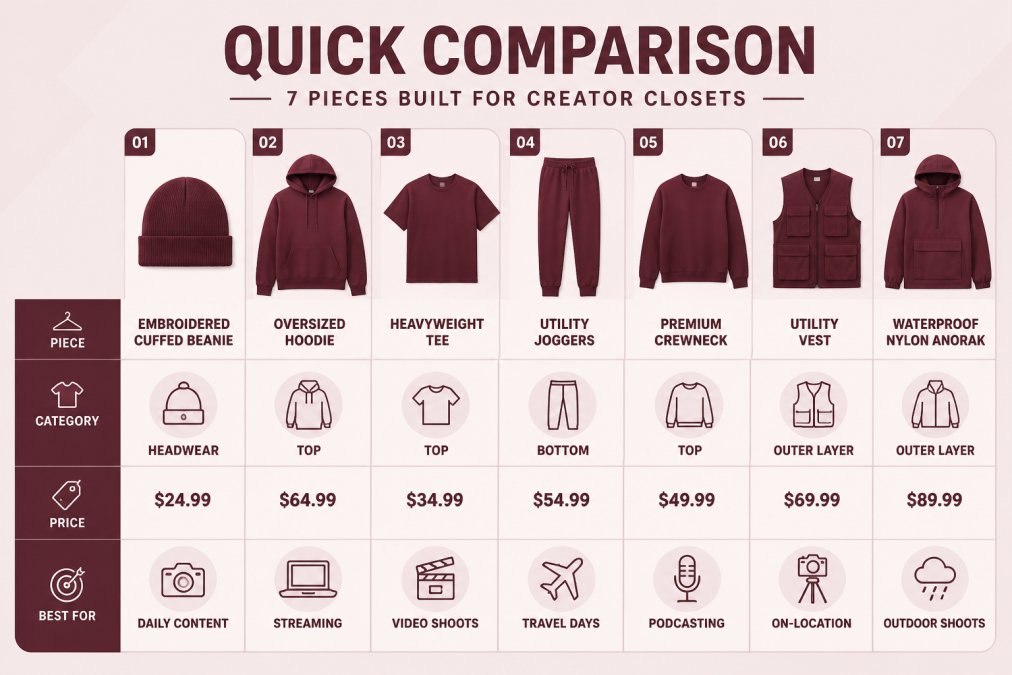
- Quick Comparison: 7 Pieces Built for Creator Closets
- 1. Neon Cityscape Graphic Tee: The On-Camera Anchor
- 2. Waterproof Nylon Anorak Jacket: Weather-Proof, Feed-Ready
- 3. IZM Logo Hoodie: The Pigment-Dyed Everyday Layer
- 4. Embroidered iZM Cuffed Beanie: The Minimalist Finisher
- 5. Multi-Function Chest Bag: Hands-Free Carry for Shoot Days
- 6. Mens Plaid Shark Backpack: Camera Bag Energy Without the Bulk
- 7. Wireless Lavalier Microphone with Noise Reduction
- How to Style Modern Streetwear for Video Production
- Building a Creator Wardrobe That Actually Works
- Frequently Asked Questions
Last Updated: September 10, 2026
What Modern Streetwear Means for Digital Creators in 2026
Modern streetwear for digital creators is a working uniform for people whose job is to be on camera, on location, and on brand at all times. This guide from Planet iZM breaks down the pieces that earn their place in a creator's rotation, with real prices and specific use cases.
Digital natives expect their wardrobe to perform like their content: consistent, recognizable, and built for the camera. A graphic tee that reads well in a vertical video matters more than a logo nobody can see.

Below, we'll show you what to look for, plus a comparison of seven pieces built for creator closets. But first, the part most guides skip: fit, fabric weight, and color accuracy on camera decide whether a piece works for production, not the label.
Defining the Modern Streetwear Aesthetic
The modern streetwear aesthetic is a visual language built on oversized silhouettes, high-contrast graphics, and functional layering that reads clearly on camera. It borrows from skate, surf, and hip-hop culture, filtered through a digital-first lens.
That digital-first lens separates today's streetwear from the 2015 version. A piece has to survive a ring light, a phone camera, and a compressed video feed. Saturated colorways and bold graphics hold up better than subtle texture.
The practical takeaway: choose pieces with strong silhouettes and clear graphic contrast. Quiet, muddy palettes disappear on screen.
Quick Comparison: 7 Pieces Built for Creator Closets
Here is the full lineup at a glance, with prices and the use case each piece is built for.
| Product | Category | Price | Best For |
|---|---|---|---|
| Neon Cityscape Graphic Tee | T-Shirt | $59.99 | On-camera anchor piece |
| Waterproof Nylon Anorak Jacket | Jacket | $89.99 | Outdoor and travel shoots |
| IZM Logo Hoodie (Pigment-Dyed Green) | Hoodie | $84.47 | Everyday layering |
| Embroidered iZM Cuffed Beanie | Hats | $24.99 | Minimalist finishing layer |
| Multi-Function Chest Bag | Accessories | $39.99 | Hands-free shoot days |
| Mens Plaid Shark Backpack | Backpack | $41.99 | Camera bag alternative |
| Wireless Lavalier Microphone | mini mic | $33.99 | Clean audio capture |
1. Neon Cityscape Graphic Tee: The On-Camera Anchor
The Neon Cityscape Graphic Tee solves the hardest problem in video: holding visual attention without distracting from your face. The retro-futuristic metropolis print, with teal-and-magenta highlights, gives the frame a focal point that reads clearly even on a compressed feed.

Construction matters too. It's 100% Airlume combed and ring-spun cotton, with side seams and shoulder tape that keep the shape after repeated washes (peer-reviewed research).
At $59.99, it sits above fast-fashion pricing. You are paying for print durability and a cut that survives a full production day.
2. Waterproof Nylon Anorak Jacket: Weather-Proof, Feed-Ready
Outdoor shoots end early when the weather turns. The Waterproof Nylon Anorak Jacket is built for that scenario, with a 100% nylon 330D shell and an interior PU coating rated at 10,000 mm water pressure resistance.
The spec sheet separates it from a fashion-only jacket (europa.eu). Breathability sits at 5,000, and the three-panel hood with mesh liner keeps rain off your face and gear. Hidden snaps, side slit pockets, and elastic cuffs round out a design built for movement, not a lookbook.
At $89.99, it's the most expensive piece here, and it earns that spot if you shoot outdoors. If your content is studio-based, skip it.
3. IZM Logo Hoodie: The Pigment-Dyed Everyday Layer
Pigment-dyed fabric does something most hoodies can't: it looks better as it ages. The IZM Logo Hoodie in muted olive settles into a lived-in texture, so your on-camera layer never looks stiff after the first month.

The build is an 80% cotton, 20% polyester blend with a 100% cotton face. A jersey-lined hood, front pouch pocket, and split-stitch double-needle seams give it the durability to survive constant rotation.
The drawback is fit variance. Pigment dyeing can shift how a garment drapes, so size up for the oversized streetwear silhouette rather than a regular fit (peer-reviewed research).
4. Embroidered iZM Cuffed Beanie: The Minimalist Finisher
A beanie is the cheapest way to make a plain outfit look intentional. This cuffed knit, embroidered with a small iZM monogram, does that for $24.99 without turning your head into a billboard.
The 12-inch cuff creates a structured silhouette that holds its shape. The turbo acrylic knit layers cleanly under the anorak or hoodie.
Where it falls short: one size fits most means it runs snug on larger heads. If you're between sizes, the Handwritten iZM Beanie at $29.99 offers a different cuff profile worth comparing.
5. Multi-Function Chest Bag: Hands-Free Carry for Shoot Days
Chest bags have quietly replaced the fanny pack as the default creator carry, and this one is built around the need for hands-free access to essentials.
The PU exterior with nylon lining holds up to daily use, and concealed compartments give you somewhere secure to stash valuables on a crowded shoot. It fits devices up to 8 inches, and the collapsible design packs flat in a larger bag when traveling between locations.
At $39.99, it's the practical pick here. It won't make an outfit, but it will make a shoot day easier.
6. Mens Plaid Shark Backpack: Camera Bag Energy Without the Bulk
Camera bags are expensive and they look like camera bags, a problem when you're shooting lifestyle content and want your gear to disappear into the frame. This backpack solves that with a plaid shark pattern that reads as streetwear first, utility second.
Under the design, it's a functional carry: waterproof nylon exterior with polyester lining, multiple compartments, and a padded section that fits up to a 12-inch laptop. Capacity sits below 20 liters, so it's a day bag, not a travel pack. Curved shoulder straps and a lightweight frame keep it comfortable through a full shoot.
The limitation is volume. If you carry a full-frame camera, two lenses, and a tripod, this won't hold it all. For mirrorless setups and phone-first creators, it's enough.
7. Wireless Lavalier Microphone with Noise Reduction
Bad audio can negatively impact video quality, and this lavalier mic offers a significant upgrade. Bluetooth 5.3 removes the cable, and intelligent noise reduction filters background sound so your voice stays clear on a busy street or in a noisy café.
Dual-channel recording supports two microphones at once, which matters if you interview guests or co-host. Battery life runs 6 to 8 hours on a single charge, enough for a full production day, and the mini clip-on form factor stays discreet on camera. Frequency response spans 20Hz to 20KHz with a signal-to-noise ratio above 70dB.
At $33.99, it costs less than most accessories here and affects the final product more than any of them.
STAY LOCKED IN WITH PLANET iZM →
How to Style Modern Streetwear for Video Production
Styling for video is a different discipline than styling for a mirror. The camera compresses contrast, flattens texture, and punishes busy patterns near the face. Three rules cover most of it.
First, keep the top half simple and the graphics bold, a strong graphic tee under a plain layer gives the frame one clear focal point. Second, avoid fine stripes and dense micro-patterns, which shimmer on camera. Third, test every outfit under your actual lighting before a shoot; colors that look rich in daylight can turn muddy under a ring light.
For a repeatable on-camera look, build a small capsule: two graphic tees, one hoodie, one outer layer, one beanie, and one bag. That covers studio, street, and travel shoots without a full wardrobe reset.
Protecting Your Designs: What Creators Get Wrong About IP
Styling is the visible half of a creator wardrobe. The invisible half is ownership, and it is where most digital creators lose money without realizing it. If you design a graphic, slogan, or repeating pattern and put it on apparel, you are creating intellectual property, and the default rules do not protect you the way most people assume.
Copyright attaches automatically, but registration changes your leverage. Under U.S. copyright law, a qualifying original graphic or print design is protected the moment it is fixed in a tangible medium, including a digital file, you do not need to file anything to own the basic right. Registration with the U.S. Copyright Office buys you the ability to sue for infringement in federal court and, for timely registration, eligibility for statutory damages and attorney's fees. Register the design before the first public drop, not after it goes viral.
Trademarks protect the name and logo, not the artwork. A brand name, wordmark, or logo used in commerce can be protected under trademark law, and the U.S. Patent and Trademark Office maintains the federal register. A graphic tee with a distinctive brand mark does double duty: the artwork may be a copyright asset, the mark on the label or chest a trademark asset. These are separate filings with separate fees and timelines, and confusing them is a common mistake.
Design patents are a narrow, expensive tool. A design patent from the USPTO can protect the ornamental appearance of an article of manufacture, but it is a poor fit for most apparel graphics. It is slow, costly for a small brand, and does not cover the flat two-dimensional print most creators sell. Treat it as a tool for hardware or distinctive product shapes, not a tee graphic.
Print-on-demand does not transfer ownership to you automatically. When you upload a design to a print-on-demand platform, its terms of service typically grant it a license to produce and ship your item, not an assignment of your copyright. Read the terms for two things: whether you retain ownership of the artwork, and whether the platform can use your design in its own marketing. Most major platforms let you keep ownership, but the marketing-use clause is where creators get surprised.
Infringement risk runs both directions. Using a band logo, sports team mark, cartoon character, or recognizable brand's trade dress on your apparel without a license is infringement, even if you redraw it. Parody and fair use exist, but they are fact-specific defenses, not a blanket permission slip. If a design is inspired by someone else's protected mark, get written permission or change the design until it is independently distinctive.
Practical steps for a creator drop. Keep dated source files and drafts to establish authorship. Register the designs you plan to sell at scale before launch. File a trademark application for your brand name once you are using it in commerce. Read the POD terms of service for the ownership and marketing clauses. Keep a simple record of every design's origin, the creator who can show a dated file trail wins a dispute.
Styling Around the Legal Layer
The styling rules and the IP rules meet in one place: your signature look. A recognizable silhouette plus a registered graphic plus a trademarked label is a defensible brand identity, not just an outfit, the difference between a creator who trends for a month and one who owns a look.
Building a Creator Wardrobe That Actually Works
The pieces above share a trait that matters more than any single feature: they were chosen for how they perform in production, not just how they look in a product photo. Silhouette, fabric weight, and graphic contrast decide whether a piece survives a shoot day, and price is only worth paying when it buys durability you'll use.
But there is a second standard most streetwear guides skip, and it is the one digital creators are increasingly asked about by their own audiences: sustainability. A creator wardrobe that photographs well but is built on disposable production is a brand liability in 2026. Digital-first streetwear has a structural advantage here that traditional retail does not.
Why Digital-First Streetwear Can Be More Sustainable
The traditional apparel model often involves overproduction. Print-on-demand can mitigate this by producing designs only after an order is placed, which can reduce unsold inventory. For a creator selling to an audience, this can be a significant sustainability lever.
Creators who take this seriously treat production method as a design constraint, not an afterthought. If a garment cannot be made on demand without compromising the print or the fit, it does not go in the drop.
What to Actually Look For
Fiber choice. Cotton is the default for graphic tees, but not all cotton is equal. Organic cotton is grown without synthetic pesticides and certified under the USDA National Organic Program, which sets the production standard for the organic label in the United States. Ring-spun and combed cotton, like the Airlume combed and ring-spun cotton in the Neon Cityscape Graphic Tee, produces a smoother, stronger yarn that can survive more wash cycles.
Recycled and lower-impact synthetics. For outerwear and bags, recycled polyester and recycled nylon reduce demand for virgin petroleum-based fiber. The Global Recycled Standard (GRS) is the certification to look for on a recycled-content claim, because it verifies the recycled input and traces it through the supply chain. A jacket or backpack with a GRS claim makes a verifiable statement, not a marketing one.
Dye methods. Pigment dyeing, like the process behind the IZM Logo Hoodie, can use less water and energy than conventional piece dyeing in some setups and produces a lived-in fade. The trade-off is real: pigment-dyed garments can vary in shade and drape, which is why sizing up is often necessary. Lower-impact dyeing and perfect consistency rarely come together.
Print method. Direct-to-garment (DTG) and direct-to-film (DTF) printing are the two dominant on-demand methods. DTG uses water-based inks that bond to the fiber and produce a soft hand feel, but performs best on 100% cotton. DTF prints onto a film transferred to the garment, which works on cotton, polyester, and blends, but adds a plastic-based transfer layer. For print durability and potentially lower material impact, DTG on cotton can be a good default.
Packaging and shipping. Poly mailers are common in e-commerce, but recycled-content and compostable mailers are available. For a creator shipping to their own audience, switching mailers can be a low-effort change with potential benefits.
The Honest Trade-Offs
Sustainability in on-demand apparel can involve cost considerations. Organic and recycled fibers may carry a cost premium that can be reflected in retail price. The creator's job is to decide which claims are worth paying for and communicate them honestly.
Greenwashing is a legal risk, not just a reputational one. The Federal Trade Commission's Green Guides set the standard for environmental marketing claims in the United States, and an unsubstantiated claim like "eco-friendly" can draw scrutiny. Specific, verifiable claims, "made with GRS-certified recycled nylon," "printed on demand to reduce overproduction", are safer and more persuasive than vague ones.
The Creator Wardrobe Standard
Put the two standards together and the rule is simple: a piece earns its place if it performs on camera, survives repeated washing, and can be produced without overproduction. That is the standard Planet iZM builds its catalog around. The sci-fi-themed apparel line, the lifestyle accessories, and the iZM Genetics wellness range are offered by Planet iZM. For individuals who want a consistent visual identity across their content and off-camera life, that consistency can be a key benefit.
Frequently Asked Questions
What streetwear is trending for digital creators right now?
Modern streetwear for digital creators in 2026 leans toward graphic tees with original artwork, pigment-dyed hoodies, and functional accessories that read well on camera. Pieces like the Neon Cityscape Graphic Tee ($59.99) and the IZM Logo Hoodie ($84.47) prioritize visual identity over loud logos. Creators are also mixing in tech-forward gear such as wireless lavalier microphones ($33.99) to keep the aesthetic cohesive from outfit to audio.
How does futuristic fashion influence personal branding for creators?
Futuristic streetwear brands give creators a visual language that signals innovation without saying a word. Sci-fi-themed apparel, neon colorways, and structured silhouettes help viewers recognize your content instantly. When your on-camera look matches your niche, whether that is tech reviews, gaming, or digital art, your personal brand becomes easier to recall. The key is consistency: pick two or three signature pieces and rotate them rather than chasing every trend.
How do I style streetwear for video production without looking overdone?
Start with one statement piece and keep the rest neutral. A graphic tee like the Neon Cityscape Tee works best with plain denim or black joggers. For outdoor shoots, the Waterproof Nylon Anorak ($89.99) adds texture without competing with your face on camera. Avoid busy patterns near the collar, and test your outfit under your actual lighting before recording. Layering a beanie or chest bag can also break up the frame and add visual interest.
What are the best streetwear brands for tech-focused influencers?
The best options combine original design with practical details. Look for brands that offer graphic tees with clean prints, hoodies with durable stitching, and accessories that double as gear. Planet iZM is one example, with pieces like the Mens Plaid Shark Backpack ($41.99) that fits a 12-inch laptop and the Multi-Function Chest Bag ($39.99) for hands-free carry. Prioritize brands that publish real product specs and care instructions so you know the piece will survive repeated wear.
Why is sci-fi-themed apparel becoming popular in the creator economy?
Sci-fi themes tap into the same visual language as gaming, VR, and digital art, which are core content categories. Creators who work in those spaces use futuristic clothing to reinforce their niche. The aesthetic also photographs well under LED lighting, ring lights, and neon setups that many creators already use. As more digital natives enter the creator economy, demand for apparel that feels brand-ready rather than generic continues to grow.