


Table of Contents
- Why Most Streetwear Fails the Quality Test
- The Streetwear Fabric Weight Guide: GSM and What It Tells You
- Identifying Screen Print Quality on Graphics
- Stitching, Collars, and Hardware: The Durability Check
- How to Spot Premium Manufacturing vs. Fast Fashion
- Counterfeit Identification Guide for Streetwear
- Wash-Test Longevity: What Survives 20 Washes
- Best Streetwear Brands 2025: Where Quality Meets Design
- Frequently Asked Questions
Last Updated: September 9, 2026
Why Most Streetwear Fails the Quality Test
The streetwear market is flooded with garments that look premium in product photos but degrade after a few washes. Spotting high quality streetwear requires reading the physical evidence of a garment: fabric weight, stitching density, collar construction, and printing method.
The Streetwear Fabric Weight Guide: GSM and What It Tells You
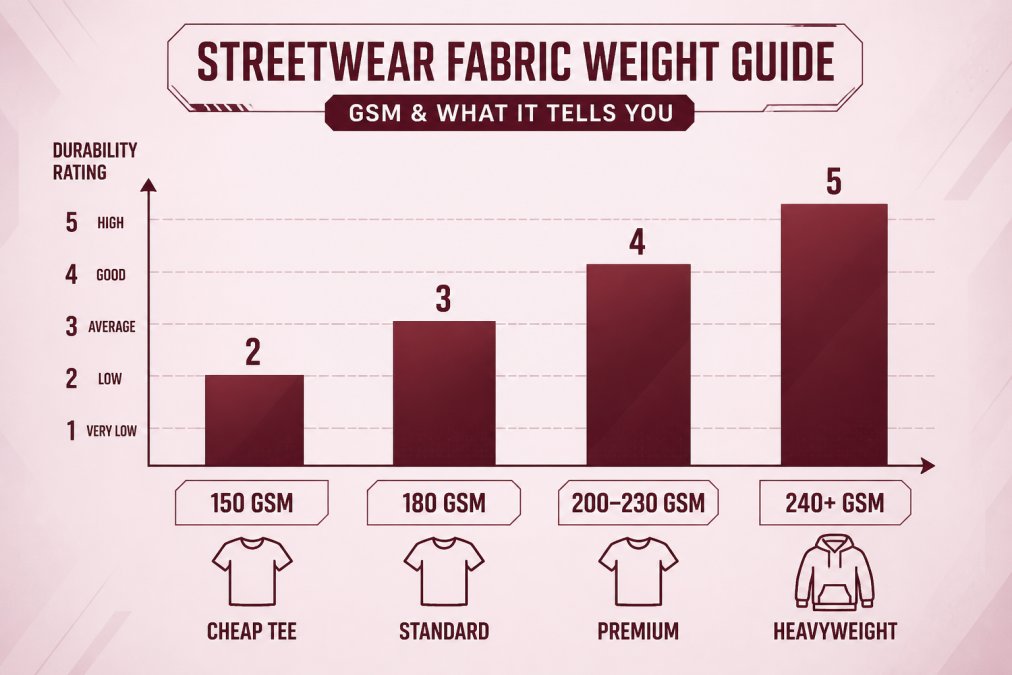
GSM (grams per square meter) is the single most reliable indicator of fabric quality in streetwear (peer-reviewed research). This metric measures textile density, directly correlating with durability and drape.
Here is a practical breakdown of what different GSM ranges mean for a t-shirt:
| GSM Range | Typical Quality | Durability | Best For |
|---|---|---|---|
| 120-150 GSM | Budget / Fast Fashion | Low | Promotional tees, layering |
| 150-180 GSM | Standard | Medium | Everyday basics |
| 180-220 GSM | Premium | High | Structured fits, daily wear |
| 240+ GSM | Heavyweight | Very High | Statement pieces, longevity |
Garments under 150 GSM are often see-through and lose their shape quickly. Premium streetwear typically sits in the 180-230 GSM range, while heavyweight cotton at 240+ GSM holds its silhouette over time.
Identifying Screen Print Quality on Graphics
The print method determines whether your graphic cracks or fades into a vintage aesthetic. Screen printing is the industry standard for high quality streetwear graphics because it layers thick, opaque ink directly into the fabric (the FDA). This creates a durable bond that flexes with the garment.
Direct-to-garment (DTG) printing, while popular for small batches, often produces a thinner feel that can wash out faster. When examining screen print quality, look for these markers:
- Crack test: Bend the graphic sharply. Premium screen print should flex without immediate cracking.
- Raised texture: Quality screen ink should feel slightly raised on the surface, indicating a thick layer of ink.
- Color saturation: The graphic should be opaque. If the fabric color shows through the ink on a dark tee, the print is thin.
- Edge sharpness: Look for clean, crisp edges on fine details. Bleeding or fuzzy lines indicate a rushed job.
Stitching, Collars, and Hardware: The Durability Check
Fabric weight means nothing if the garment falls apart at the seams. The stitching is the skeleton, and high quality streetwear uses specific techniques to reinforce stress points.
Check the following areas:
- Double-stitched seams: Run your fingers along the inside of the side seams. You should feel two parallel rows of stitching, not one. Double stitching prevents the fabric from unraveling and adds structural integrity.
- Ribbed collar integrity: The collar should be a separate piece of ribbed knit that snaps back into shape when stretched. A high quality ribbed collar is tight and resilient. A collar that stretches out and stays loose is a sign of cheap elastic or poor construction.
- Shoulder-to-shoulder taping: Look for a strip of fabric running across the back of the collar inside the shirt. This tape prevents the shoulder seam from stretching and is a hallmark of better manufacturing.
- Hardware durability: For hoodies and jackets, check the zippers, aglets, and eyelets. Zippers should be made of metal or heavy-duty nylon, not cheap plastic that binds. Aglets (the plastic or metal tips on drawstrings) should be securely crimped, not sliding off.
Garment-dyed pieces require special attention, as dyeing can weaken fibers.
How to Spot Premium Manufacturing vs. Fast Fashion
The difference between premium manufacturing and fast fashion comes down to supply chain transparency and batch-level quality control. Fast fashion optimizes for speed and cost; premium brands invest in dedicated production runs and documented QC records.
Here is how to spot the distinction:
- Fabric composition: Check the label. Premium pieces often use 100% combed cotton or specific blends like French terry for hoodies. Fast fashion frequently uses high-polyester blends to cut costs.
- Shrinkage control: Look for "pre-shrunk" or "fabric laundered" on the label. This treatment prevents the garment from warping in the wash. High quality streetwear brands specify this because they expect the garment to last.
- Batch production: Premium brands produce in smaller, controlled batches. This allows for inspection at every stage. Mass-market production runs are harder to monitor, leading to inconsistencies between units.
- Garment construction details: Details like sideseamed bodies (which prevent twisting) and tear-away labels (for comfort) are cost-adders that signal a brand cares about the end-user experience.
Fast fashion is designed for a season; premium manufacturing is designed for a wardrobe. The price difference reflects the cost of better materials, ethical labor, and quality control. When you buy a piece that has passed rigorous inspection, you are paying for longevity, not just a logo.
The Technical Fabric Breakdown: French Terry vs. Loopback vs. Fleece
Most guides stop at "cotton," but the specific knit structure determines how a hoodie or sweatshirt performs over time. Understanding the weave tells you about weight, drape, and pilling resistance before you feel the fabric.
Here is the breakdown of the three dominant knit structures in premium streetwear:
- French Terry: This is a mid-weight knit with smooth loops on the inside and a flat, clean face on the outside. It is the workhorse of premium streetwear because it breathes well, drapes naturally, and resists pilling better than brushed fleece. A quality French terry hoodie typically weighs 240-300 GSM and holds its structure without feeling stiff. The loopback texture on the inside is a sign of a true French terry, not a brushed imitation.
- Loopback (Unbrushed Fleece): Loopback is the technical term for the unbrushed interior of a sweatshirt. It is essentially the same construction as French terry but often heavier, ranging from 300-400 GSM. The loops are more pronounced, creating a thermal layer that traps heat. High-end brands like those producing in Los Angeles or Portugal often use loopback for heavyweight hoodies because it does not pill or shed like brushed fleece. If you see a hoodie described as "loopback cotton," that is a marker of a garment built for years of wear.
- Brushed Fleece: This is the soft, fuzzy interior found on most mass-market hoodies. The brushing process raises the fibers to create warmth and softness, but it also weakens the yarn structure. After 10-15 washes, brushed fleece tends to pill on the inside and lose its loft. It is not inherently low quality, but it is a sign that the brand prioritized initial comfort over long-term durability.
How to Read a Fabric Composition Label Like a Buyer
The label is the fastest way to separate premium from fast fashion, but you need to know what to look for beyond the word "cotton."
- 100% combed cotton: Combed cotton has been processed to remove short fibers and impurities, leaving only long, strong staples. This produces a smoother, stronger yarn that resists pilling. If the label does not say "combed," it is likely carded cotton, which is cheaper and weaker.
- Cotton-polyester blends (e.g., 50/50 or 52/48): These are common in fast fashion because polyester is cheaper and resists wrinkles. The trade-off is that polyester does not breathe, traps odor, and can develop a permanent sheen or "shine" after repeated washing. A high polyester content (over 35%) is a red flag for a premium streetwear piece.
- Tri-blends (cotton/polyester/rayon): These are soft and drape well, but they are typically lighter weight (140-160 GSM) and less durable. They are fine for vintage-style tees, but they are not built for the same longevity as a 200+ GSM 100% cotton piece.
- Spandex or elastane (2-5%): This is added for stretch and recovery. It is common in premium joggers and fitted pieces, but it degrades with heat. If you see spandex, the garment requires cold-water washing to maintain its shape.
The Role of Cut-and-Sew vs. Blank Manufacturing
A major distinction that most guides miss is whether a brand is printing on a stock blank or using a cut-and-sew manufacturer. This determines how much control the brand has over the final product.
- Blank manufacturing: The brand buys pre-made garments (blanks) from a supplier like Gildan, Hanes, or Next Level, and then prints on them. This is how most streetwear brands start. The quality is entirely dependent on the blank. A 5.3 oz. Gildan G500 is a solid mid-weight option, while a 6.1 oz. Next Level or a 7.5 oz. Independent Trading Co. hoodie is a step up. The key is to check the blank's specifications, not the brand's marketing.
- Cut-and-sew manufacturing: The brand designs the garment from scratch, sources the fabric, and has it cut and sewn in a factory. This allows for custom fits, unique fabric blends, and reinforced construction details that are impossible with stock blanks. Cut-and-sew pieces are almost always more expensive because the brand is paying for pattern making, sampling, and dedicated production runs. If a brand claims to be premium but uses a stock blank without disclosing it, that is a disconnect between marketing and manufacturing reality.
Fast fashion is designed for a season; premium manufacturing is designed for a wardrobe. The price difference reflects the cost of better materials, ethical labor, and quality control. When you buy a piece that has passed rigorous inspection, you are paying for longevity, not just a logo.

Counterfeit Identification Guide for Streetwear
Counterfeit streetwear is a growing problem, and spotting a fake requires a forensic approach. High-value drops are prime targets, and counterfeiters almost always cut corners on the details that matter most.
Use this checklist to authenticate a garment:
- Check the neck label: Legitimate brands use high-quality woven labels with crisp, sharp text. Fakes often have blurry printing or misspellings. Look for the fabric composition and country of origin.
- Verify the print quality: Compare the graphic to official product photos. Counterfeiters often use low-resolution files, resulting in a muddy or pixelated print.
- Inspect the stitching on the tags: Authentic tags are sewn on cleanly with matching thread. Fakes may have loose threads or mismatched stitching.
- Feel the hardware: On hoodies and jackets, zippers should feel solid and move smoothly. Fake hardware is often lightweight and feels hollow.
- Check the price: If the deal seems too good to be true, it is. Counterfeiters rely on pricing that undercuts the retail value by 30-50% or more.
- Look for a hologram or QR code: Many premium brands now include authentication features. If the brand uses them, the absence is a red flag.
Wash-Test Longevity: What Survives 20 Washes
The true test of high quality streetwear is not how it looks on day one, but after 20 washes. A premium garment should emerge with its color, shape, and graphics intact.
What to expect from a high quality piece after 20 washes:
- Colorfastness: The dye should hold. There should be minimal fading, and the garment should not bleed onto other clothes.
- Shape retention: The collar should still be snug, and the hem should not have twisted or warped.
- Print integrity: The graphic should show normal wear, perhaps a slight fade, but no large cracks or peeling.
- Pilling resistance: The fabric surface should remain smooth. Pilling (small balls of fiber) indicates weak, short-staple cotton.
To protect your investment, always wash streetwear in cold water and hang it to dry. The heat from a dryer is the single biggest killer of graphics and elastic fibers.
Best Streetwear Brands 2025: Where Quality Meets Design
Finding high quality streetwear means finding brands that refuse to compromise on construction. For a futuristic, sci-fi aesthetic without sacrificing durability, Planet iZM offers apparel that aligns with the quality checklist above.
Our apparel includes options like the lightweight Neon Cityscape Graphic Tee and the Gildan G500, which provides a 5.3 oz. foundation for graphics. We also offer the Next Level 6010 Triblend Crew, which is fabric-laundered for reduced shrinkage.


What separates many streetwear brands is a commitment to the entire product lifecycle, focusing on fabric weight, print durability, and honest construction.
For a truly immersive experience that blends premium apparel with a forward-thinking community, Planet iZM offers exclusive designs you won't find elsewhere. When you invest in a piece from a brand that prioritizes quality, you are building a wardrobe that lasts, not just a collection of hype items.
The Authentication Checklist: Separating Real Quality from Counterfeit Hype
The most common failure point in streetwear is not quality, it is authenticity. Counterfeiters replicate logos and packaging but fail on the physical details that define genuine manufacturing.
Use this forensic checklist when evaluating a piece from any brand:
- The Neck Label Micro-Print Test: Genuine brands use woven labels with sharp, legible text. Counterfeiters often use printed labels that blur under magnification. Use your phone's camera to zoom in on the label. If the text is fuzzy at the edges or the thread count of the weave is visibly loose, that is a red flag. Look for the fabric composition and the RN number (a registration number issued by the Federal Trade Commission), a missing RN number is a strong indicator of a non-compliant manufacturer.
- The Stitch Density Check on Tags: Authentic tags are sewn with a consistent stitch density (typically 8-12 stitches per inch) and thread that matches the label color. Fakes often have loose threads, mismatched thread colors, or visible glue residue where the tag was attached. Run your fingernail along the edge of the tag, if it catches on rough fibers or uneven stitching, the garment did not pass a quality inspection.
- The Hardware Weight Test: On hoodies and jackets, zippers are the most counterfeited component. Genuine zippers from YKK or Riri feel solid and move with a smooth, consistent action. Fake zippers often feel hollow, have sharp edges, or bind at the same spot every time. Similarly, aglets (the tips on drawstrings) should be metal or securely crimped plastic. If an aglet slides off or is loose, the drawstring was not finished properly.
- The Print Resolution Check: Counterfeiters often use low-resolution source files for graphics. Compare the print to official product photos from the brand's website. Look at fine details like text or small linework. If the edges are muddy, pixelated, or bleeding into the fabric, the print was likely made from a stolen or low-quality file. Genuine screen prints have crisp, clean edges.
- The QR Code and Hologram Verification: Many premium brands now include authentication features such as QR codes, NFC chips, or holographic stickers. If the brand uses these, scan the code and verify it directs you to the official product page. A QR code that leads to a dead link or a generic website is a counterfeit. However, note that the absence of these features is not proof of a fake, only a red flag if the brand's official products include them.
- The Price-to-Retail Ratio Test: Counterfeiters rely on pricing that undercuts retail by 30-50% or more. If a piece that retails for $120 is listed for $60, the probability of it being counterfeit is extremely high.
How to Vet a Brand's Quality Claims Before You Buy
Beyond authentication, the best way to spot a high quality brand is to evaluate its transparency. Here is what to look for on a brand's product page or lookbook:
- GSM and fabric weight listed: If a brand lists the GSM of its hoodies or tees, that is a sign of confidence in the product. Brands that hide this information are often using low-grade blanks.
- Blank manufacturer disclosed: If a brand prints on stock blanks, it should be willing to tell you which blank it uses. A brand that says "premium heavyweight tee" without naming the blank is often using a generic, low-cost option.
- Wash and care instructions specific to the fabric: A brand that specifies "cold wash, hang dry" is acknowledging the garment's construction, while "machine wash, tumble dry low" often signals polyester blends that degrade faster.
- Batch numbers or production dates: Some premium brands include batch numbers or production dates on their tags. This allows for traceability and indicates a controlled production run. Mass-market brands rarely do this because they produce continuously.
For a truly immersive experience that blends premium apparel with a forward-thinking community, Planet iZM offers exclusive designs you won't find elsewhere. When you invest in a piece from a brand that prioritizes quality, you are building a wardrobe that lasts, not just a collection of hype items.
Frequently Asked Questions
What is the 3-3-3 rule for clothing?
The 3-3-3 rule is a quick quality screening method: check 3 key areas (fabric, stitching, and print or dye), look for 3 specific details in each area, and spend 3 minutes inspecting the garment before buying. For high quality streetwear, this means checking GSM weight, seam construction, and print flexibility. If the fabric feels thin, the seams pull, or the print cracks when stretched, it fails the test.
Why is fabric weight important in streetwear hoodies and tees?
Fabric weight, measured in GSM, determines how a garment drapes, feels, and survives repeated washing. Standard tees around 150-180 GSM feel light and may go see-through quickly. Premium streetwear tees typically range 200-230 GSM, while heavyweight hoodies start at 300 GSM. Heavier cotton with a tight knit resists stretching, holds its shape, and develops a better hand-feel over time. Always check the GSM spec before buying.
How do you identify durable stitching in urban apparel?
Look for double-stitched or reinforced seams on high-stress areas like shoulders, side seams, and hems. Quality streetwear uses 7-10 stitches per inch with thread that matches the fabric color. Check that seams lie flat without puckering. Shoulder-to-shoulder taping prevents stretching at the neckline. Sideseamed construction means the garment keeps its shape better than tubular knits. If you can pull the fabric apart at a seam easily, the stitch density is too low.
Does a higher price tag always mean better quality streetwear?
No. Price reflects branding, hype, and resale positioning as much as materials. Some premium brands charge $80 for a 180 GSM tee that costs $12 to produce. The key is checking whether the price matches the actual construction: fabric weight, print technique, and reinforcement details. A $40 tee with 230 GSM combed cotton and double-stitched seams can outperform a $120 tee with thin fabric and a fast-fashion print. Evaluate the garment, not the label.
The streetwear industry will always have its trends, but the fundamentals of quality remain constant. The challenge is filtering through the noise to find garments that respect your money and your time. Planet iZM was built on the principle that futuristic design and premium construction should not be mutually exclusive. Explore our collection to see how high quality streetwear should look and feel, and get started with Planet iZM to build a wardrobe that stands apart.