


Table of Contents
- The 6-Point Quality Check for Streetwear
- What Is GSM in Clothing and Why It Decides Everything
- Fabric Weight, Hand-Feel, and Drape: Reading the Garment
- Stitching, Seams, and Hardware: Where Quality Shows
- How to Spot the Best Curated Streetwear Aesthetic Brands
- Resale Authentication and Sustainable Quality vs. Hype
- Frequently Asked Questions
Last Updated: September 14, 2026
The 6-Point Quality Check for Streetwear
Identifying quality streetwear comes down to six physical checks you can run in under two minutes: fabric weight, hand-feel and drape, stitch density, seam reinforcement, hardware durability, and print integrity. At Planet iZM, we handle a lot of futuristic, sci-fi-themed apparel, and the same rules separate a garment that survives fifty washes from one that pills by round three. Below, we'll show you how to run each check, plus two angles most guides skip: resale authentication and sustainable construction versus hype.
A garment can photograph beautifully and still be built from thin, loosely knit fabric with single-stitched seams and a zipper that fails within a season. Quality lives in details you cannot see in a product photo, which is why strong marketing can pass off weak construction for years.
Why Most Shoppers Miss the Signs
The biggest mistake is touching a garment once and deciding. Fabric softness at the rack is often a finishing treatment, not a sign of durable fiber, a washed, softened finish can mask a thin knit and disappears after a few laundry cycles.
A second blind spot: shoppers check the front and never turn a garment inside out. The interior tells the real story, look for serging along the seams, clean seam allowances, and reinforced stress points at the shoulders and armholes.
What Is GSM in Clothing and Why It Decides Everything
GSM in clothing is grams per square meter, a measurement of fabric weight that indicates density, durability, and structure. Higher GSM generally means a heavier garment that holds its shape and resists wear.
For streetwear, GSM is the single most useful number on a spec sheet, and most brands bury or omit it.
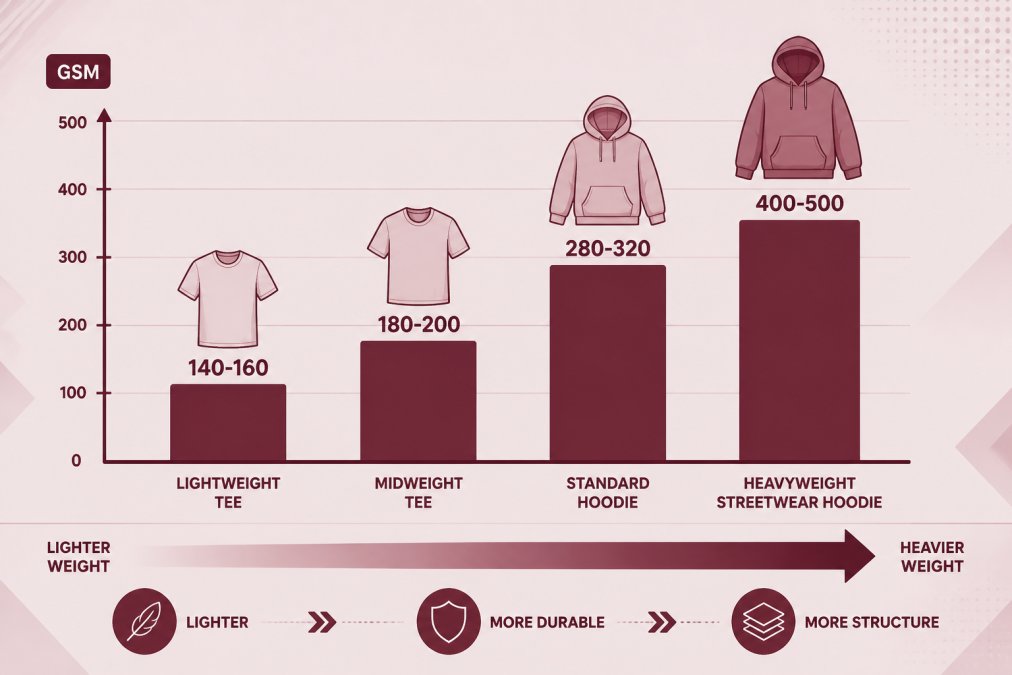
GSM Ranges That Matter for Hoodies and Tees
A lightweight tee sits around 140-160 GSM, a midweight tee around 180-200 GSM, a standard hoodie near 280-320 GSM, and a heavyweight streetwear hoodie between 400-500 GSM. Below 140 GSM, fabric goes sheer and loses shape quickly.
Heaviness is not automatically better: a 500 GSM hoodie in a humid climate feels oppressive, and breathability suffers as density climbs. Match weight to use case, 180-220 GSM for everyday tees, 300-400 GSM for a fall and winter hoodie.
Fabric Weight, Hand-Feel, and Drape: Reading the Garment
Hand-feel and drape tell you what GSM alone cannot. Hand-feel is how the fabric responds to touch, dry or slick, dense or airy. Drape is how the garment falls on the body, revealing whether the fabric holds a cut or collapses into shapelessness.
For streetwear, the fabric conversation starts with the blank, the base garment a brand prints or embroiders on. Two hoodies can both read "400 GSM" and behave completely differently depending on how the fleece is built.
French Terry vs. Fleece: The Loop Structure Tells You Everything
Turn a hoodie inside out and look at the back of the fabric. French terry shows a flat, visible loop structure, uncut loops sitting low and tight against the backing. Brushed fleece shows a fuzzy, napped surface where those loops were torn open and brushed. Both can be heavy, but they age differently.
- French terry holds its shape, breathes better, and resists pilling because the loops stay intact. It is the standard for warm-weather streetwear and for pieces meant to drape cleanly.
- Brushed fleece feels softer on day one but pills faster at friction points, under the arms, along the waistband, and where a bag strap rubs. A cheap fleece can look worn by wash ten.
A common pattern: brands advertise "heavyweight fleece" without specifying loop structure. If the interior looks fuzzy and uneven rather than looped and uniform, expect pilling.
Reading the Fiber Content Like a Spec Sheet
Natural fibers like cotton and rayon drape softly and breathe well. Synthetic blends add durability and shape retention but can feel plasticky and trap heat. A tri-blend combines polyester, combed ringspun cotton, and rayon to balance softness with structure, the Planet iZM Next Level 6010 Triblend Crew uses that 50/25/25 mix, laundered to reduce shrinkage, with shoulder-to-shoulder taping to keep the neckline from stretching (Silk/Rayon Webs and Nonwoven Fabrics).

Check the care label and fiber content first. A label listing fiber percentages, origin, and washing instructions signals transparency; vague labels saying only "cotton blend" without percentages are a warning.
Here is what the percentages actually tell you:
- 100% cotton, breathes well, takes screen prints cleanly, but shrinks unless pre-shrunk or garment-dyed.
- Cotton/poly blends (roughly 50/50 to 80/20), resist shrinkage and hold print color longer, at the cost of some breathability.
- Tri-blends (poly/cotton/rayon), soft hand, strong drape, popular for retail tees; rayon is what gives that slightly slinky feel.
- Heavy poly fleece, durable and cheap to produce, but pills and holds odor more than cotton fleece.
Drape as a Fit Signal
Hold the garment by the shoulders and let it hang. A quality cut falls in clean vertical lines with no twisting at the side seams. If the hem curls, the side seam twists forward, or the body sags unevenly, the fabric was cut off-grain or the knit has poor recovery.
Recovery is the test GSM charts skip: stretch a sleeve cuff or hem gently and release it. Quality fabric snaps back; fabric that stays stretched out has lost its elastic memory and will bag at the elbows and knees within a season.
Stitching, Seams, and Hardware: Where Quality Shows
Stitch density and seam reinforcement are where cheap garments reveal themselves fastest. Higher stitch density per inch means a stronger seam, and double-stitched or reinforced seams at stress points outlast single stitching.
Turn the garment inside out and look for serging, the overlocked stitching that prevents raw edges from fraying (britannica.com). Clean serging with no loose threads signals a controlled production line; puckering along a seam, where fabric ripples from wrong stitch tension, signals the opposite.
STAY LOCKED IN WITH PLANET iZM →
Hardware matters just as much. Run zippers up and down several times and inspect buttonhole integrity on button-front pieces. A zipper that catches or a buttonhole that frays within weeks means hardware was chosen for cost, not durability. The Planet iZM Waterproof Nylon Anorak Jacket is a useful benchmark: a #5 dyed-to-match coil zipper with a matte metal pull, a rubber pull tab, a zipper garage protecting the chin, and DTM neck taping inside, functional hardware specified deliberately.

The Light Test and Seam Inspection
Hold the fabric up to a bright light. If light passes through easily and you can see your hand's outline, the fabric is thin and likely to wear through quickly (A comprehensive review of ultraviolet radiation and functionally modified textile fabric...). A dense knit blocks most light.
For seam inspection, grip the seam between both hands and pull gently. A well-constructed seam holds without stitches separating or fabric distorting. Gaps opening between stitches mean the seam allowance is too narrow or stitch density too low.
| Check | What to Look For | Warning Sign |
|---|---|---|
| GSM | 180-220 tees, 300-400 hoodies | Under 140 GSM |
| Light test | Blocks most light | Hand outline visible |
| Seam pull | Holds under tension | Gaps open between stitches |
| Stitch density | Tight, even, no puckering | Rippling along the seam |
| Hardware | Smooth zipper, clean buttonholes | Catching zipper, fraying holes |
| Symmetry | Collar, cuffs, pockets align | Crooked seams, mismatched sleeves |
How to Spot the Best Curated Streetwear Aesthetic Brands
The best curated streetwear aesthetic brands publish fabric specifications and let you inspect construction logic before you buy. Curation is not a mood board; it is a documented standard for GSM, seam construction, and hardware.
Look for brands that name fabric weights, describe stitching, and show interior seam photos. Label transparency is the strongest single signal: when a brand tells you fiber percentages, GSM, and construction details, it is inviting scrutiny that weak brands avoid.
Planet iZM publishes exactly this kind of detail across its catalog, from the pigment-dyed IZM Logo Hoodie with its jersey-lined hood and double-stitched construction to the embroidered cuffed beanie with a structured 12-inch cuff that holds its shape. The IZM Logo Hoodie at $84.47 and the cuffed beanie at $24.99 both carry the specification transparency that separates a curated label from a print-on-demand storefront. If you want a starting point, the IZM Logo Hoodie in pigment-dyed green is the piece that best demonstrates the standard we hold the rest of the catalog to.

Resale Authentication and Sustainable Quality vs. Hype
Resale authentication is the quality check most buyers never learn, and where construction knowledge pays off twice. On the secondary market you cannot rely on brand marketing, so you rely on the garment itself: GSM, stitch density, hardware, and label accuracy.
A Four-Step Authentication Workflow
Run these in order, fakes usually fail at step one or two.
- Interior stitching first. Turn the piece inside out. Authentic production lines use consistent serging with clean, trimmed seam allowances; replicas show loose threads, uneven overlock, or raw edges. Check shoulder-to-shoulder taping and the neckline seam, the hardest details to fake at scale.
- Hardware branding and action. Run every zipper up and down several times. Authentic zippers carry consistent branding on the pull and glide smoothly; fakes use generic pulls, mismatched finishes, or zippers that snag mid-track. On snaps and buttons, mixed metal tones are a red flag.
- Label and tag accuracy. Compare the interior tag against the brand's published specifications. If the tag claims 400 GSM and the fabric passes light easily, the numbers do not match. Check that the care label, size tag, and hangtag use consistent fonts and spacing, counterfeiters often get one right and the others wrong.
- Print and embroidery consistency. On screen-printed pieces, check that print edges are crisp and ink sits on top of the fabric rather than soaking in and blurring. On embroidered logos, check stitch direction, authentic embroidery has uniform thread tension and clean edges, while fakes pucker or show loose threads at the border.
A common pattern on the resale market: a seller photographs the front and the tag but never the interior seams. Ask for interior photos before you commit. A legitimate seller will send them.
Hype Quality vs. Sustainable Quality
The second angle is sustainable-versus-hype. A garment marketed as sustainable but built from thin fabric with single stitching is neither. True sustainable quality shows up in construction that resists replacement: heavier GSM, reinforced seams, and hardware that lasts. The most sustainable garment is the one you do not have to rebuy in a year.
Hype quality is marketing-driven, leaning on scarcity, collabs, and drop culture to justify a price the construction does not support. Sustainable quality is material-driven, showing up in the specs: a published GSM, a named fabric mill or blank, reinforced stress points, and hardware chosen for function rather than cost.
A practical way to tell them apart: ask what the garment is made of and how. Hype answers with a story. Sustainable quality answers with numbers.
Frequently Asked Questions
What is the 3-3-3 rule for clothing?
The 3-3-3 rule is a wardrobe framework: three tops, three bottoms, and three pairs of shoes that can mix into nine outfits. For streetwear, it means buying fewer but higher-quality pieces that work together. Choose items with reinforced seams, mid-to-heavy fabric weight, and neutral or versatile colorways. A 400 GSM hoodie, a heavyweight tee, and durable denim will outlast a closet full of thin, trend-driven pieces that pill or lose shape after a few washes.
What are the key indicators of high-quality streetwear construction?
Check five things: fabric weight (GSM), stitch density, seam reinforcement, hardware durability, and symmetry. Quality streetwear uses double-stitched or serged seams, clean buttonhole integrity, and zippers that glide without catching. Fabric should feel substantial without stiffness, and the garment should hang evenly when held by the shoulders. Look for puckering along seams, which signals poor tension control. Alignment of patterns and labels also matters. A $84 hoodie with 400 GSM French terry and reinforced seams will outlast a cheaper option by years.
How does fabric weight impact the quality of a hoodie or t-shirt?
Fabric weight determines how a garment drapes, how long it lasts, and how it feels against your skin. A 5.3 oz (roughly 180 GSM) cotton tee is fine for layering but may thin over time. A 400 GSM hoodie holds its shape, resists pilling, and provides warmth without bulk. Heavier fabrics also take screen prints better and resist shrinkage. For streetwear, midweight starts around 250 GSM; heavyweight begins at 400 GSM. Lighter fabrics can still be quality if the yarn and knit are tight, but they will not have the same structure or longevity.
How can you tell if a streetwear brand uses ethical manufacturing practices?
Look for transparency: brands that disclose factory locations, fiber sourcing, and certifications. Check for tear-away labels that reveal manufacturing details, and look for signs of fair labor like consistent stitch quality and clean finishing. Brands that publish supply chain information or partner with recognized ethical certifiers are easier to trust. If a brand cannot tell you where or how its garments are made, that is a red flag. Sustainable quality often shows in the construction: reinforced seams, natural fibers, and a lack of chemical odor.
Why is garment weight (GSM) important in streetwear?
GSM (grams per square meter) tells you how dense and durable a fabric is. In streetwear, GSM separates a hoodie that survives 50 washes from one that pills after five. A 400 GSM French terry hoodie feels substantial, drapes cleanly, and holds screen prints without cracking. A 180 GSM tee works for summer but may lose shape. Higher GSM generally means better tensile strength, less shrinkage, and a more premium hand-feel. It is the single fastest way to judge whether a piece is built to last or built to sell.
What are the best quality streetwear brands currently on the market?
The best quality streetwear brands prioritize construction over hype. Look for brands that publish fabric weight, use reinforced seams, and offer consistent sizing. Planet iZM, for example, uses pigment-dyed finishes that age well. Other indicators: brands that show detailed product specs, offer clear return policies, and have a distinct aesthetic point of view. Avoid brands that rely solely on limited drops without disclosing materials. Quality streetwear is about what you can verify, not what the marketing claims.