


Table of Contents
- What Defines a Futuristic Wardrobe in 2026
- The Techwear Essentials to Start Your Collection
- How to Style Metallic Clothing Without Looking Like a Costume
- 5-Step Framework to Build Your Futuristic Wardrobe
- The 2026 Sci-Fi Fashion Trends That Actually Matter
- Common Mistakes to Avoid When Building Your Futuristic Wardrobe
- Final Styling Blueprint
- Frequently Asked Questions
Last Updated: September 8, 2026
Building a futuristic wardrobe is less about buying silver bodysuits and more about shifting your approach to silhouette, material, and intentionality. It is the practice of curating clothing that prioritizes structural geometry, technical fabrics, and a distinct sci-fi aesthetic over fleeting seasonal trends.
The biggest misconception is that futuristic fashion requires you to look like a space marine. In reality, the most effective looks are grounded in modular pieces and neutral palettes punctuated by one or two statement elements like reflective materials or iridescent accents.
What Defines a Futuristic Wardrobe in 2026
A futuristic wardrobe is defined by three core pillars: functional design, geometric silhouettes, and a deliberate use of material texture. This is not about costume construction; it is about applying the principles of minimalist design and textile innovation to clothes that actually perform.
The three pillars that matter most:
- Functionality: Pockets, straps, modular clothing, and weather resistance are not just decorative. They signal a purpose-built garment.
- Geometry: Sharp shoulders, asymmetric cuts, and structured volumes replace the organic, flowing lines of traditional fashion.
- Materiality: The tactile experience is crucial. You are looking for neoprene, mesh, vinyl, and technical shells that catch light differently than cotton or denim.
In 2026, the line between dystopian fashion and everyday street style has blurred, moving away from literal armor and toward sleek, utilitarian futurism. Expect the fit to feel different; these clothes are designed with structural integrity in mind, often running more boxy or exaggerated than you are used to.
The Techwear Essentials to Start Your Collection
You do not need to overhaul your closet overnight. Starting with a few core techwear essentials creates a foundation you can build on. The real differentiator between a costume and a functional futuristic garment lies in materials and construction, not just visual shape.
Your first purchases should prioritize layering and structure. A color-blocked hard-shell jacket is arguably the single most important purchase you can make, providing an instant architectural frame and practical water repellency. Look for adjustable hoods and diagonal zipper pockets.

- The Shell Jacket: This is your armor. It should be wind-resistant, breathable, and visually loud enough to anchor a look. Check the denier (a measure of fiber thickness); a 70D to 100D nylon or polyester face fabric balances durability and comfort (britannica.com). Look for a durable water repellent (DWR) finish.
- Structured Trousers: Cargo styles with articulated knees or tapered ankles create a clean techwear line. Look for a gusseted crotch for full range of motion. A nylon-spandex blend (around 5-10% stretch) maintains comfort and a sharp crease (peer-reviewed research).
- Layered Tops: Think mesh underlayers or high-neck base layers that peek out from under your main shirt. Merino wool or a polyester-elastane blend manages moisture better than cotton.
Sourcing Materials: Where to Find the Real Stuff
Most retail stores don't carry true technical fabrics. Here is a practical sourcing guide for the key materials in a futuristic wardrobe:
- Neoprene (Polychloroprene): This thick, spongy wetsuit fabric holds structure and creates sculptural shapes. Find it at fabric specialty stores or wetsuit repair retailers. Look for 3mm to 5mm thickness for panels or vests; it is not breathable, so use it for statement pieces.
- Iridescent Vinyl and PVC: For a color-shifting effect, use film-backed "holographic" or "oil slick" vinyl by the yard. Not breathable and stiff, it suits panels, bags, or trims. A lighter option is iridescent organza, a sheer nylon with a color-shifting coating that layers well over darker fabrics.
- 3M Scotchlite Reflective Material: This industry standard for retroreflective fabric creates a striking effect in strips or panels. Buy it by the yard from industrial suppliers or online marketplaces. It comes in silver and colored variants that appear grey in daylight but glow at night.
- Technical Mesh: For a futuristic look, choose rigid, structured mesh like that in sports shoes or high-end backpacks. Look for "3D mesh" or "power mesh" (typically nylon or polyester) that holds its shape when pushed.
Planet iZM carries a range of these foundational pieces, including a Color-Blocked Hard-Shell Outdoor Jacket that delivers on both aesthetic and utility. When you are ready to move beyond ready-to-wear, these sourcing tips will let you customize or commission unique pieces.
How to Style Metallic Clothing Without Looking Like a Costume
The number one fear is looking like you are headed to a sci-fi convention. The secret to styling metallic clothing is restraint and contrast, use metallic textures as a single point of focus against matte, dark, or neutral fabrics.
The 80/20 rule of metallics: Keep 80% of your outfit in matte, muted tones like black, grey, or olive. Reserve the remaining 20% for your reflective or metallic statement piece. This creates visual tension without overwhelming the eye.
Avoid pairing a metallic jacket with graphic-heavy pants or bright sneakers. Anchor the look with simple, dark basics, pair a reflective bomber with a plain black tee and matte black trousers.
For accessories, think texture over color. A matte black bag with silver hardware or technical gloves echoes the vibe without competing. If new to this, start with metallic footwear or a single accessory before committing to a full metallic outerwear piece.

5-Step Framework to Build Your Futuristic Wardrobe
Building a cohesive collection requires a system, not just a shopping spree. This framework moves you from chaos to a curated, functional wardrobe, forcing you to consider how each piece functions as part of a system.
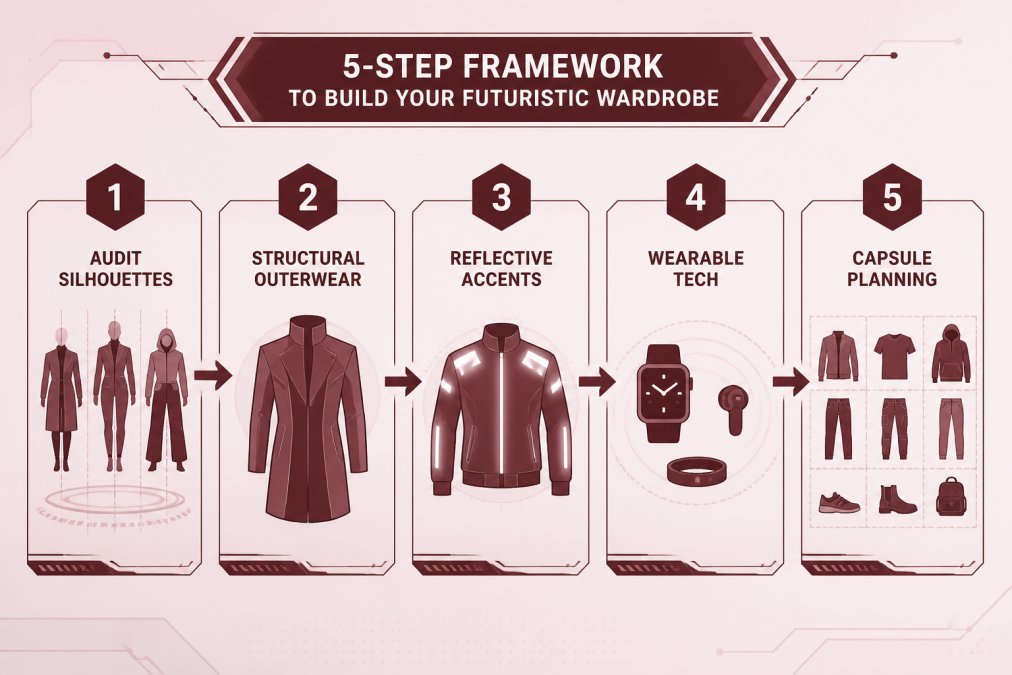
Step 1: Audit Your Current Silhouettes
Before buying anything new, evaluate what you own. Look for pieces with clean lines, technical fabrics, or unusual cuts that already fit the brief, a base to build on.
Pull out anything in black, grey, or olive. Try on your outerwear and assess its shape; if overly baggy or lacking structure, it will fight against futuristic pieces. This step identifies gaps in your silhouette vocabulary.
Step 2: Invest in Structural Outerwear
Outerwear is the anchor of the futuristic wardrobe. A single, high-quality structural piece transforms an outfit more than any other item, so spend the bulk of your budget here.
Look for jackets with defined shoulder lines, asymmetric zippers, or high collars. The Color-Blocked Hard-Shell Jacket from Planet iZM offers a water-repellent finish and diagonal zipper pockets, designed to be the centerpiece of a daily rotation.
Step 3: Add Reflective and Iridescent Accents
Once your base is solid, introduce one or two reflective or iridescent items, sneakers with 3M detailing, a holographic bag, or a paneled shirt. The key is scarcity; one accent per outfit is the maximum.
Step 4: Integrate Wearable Tech
Wearable technology separates a costume from a genuinely modern wardrobe. It does not mean strapping a computer to your face; it means integrating functional tech that enhances the garment's purpose.
STAY LOCKED IN WITH PLANET iZM →
Start with Passive Tech: The easiest entry point is smart materials. Look for phase-change materials (PCMs) in base layers, these absorb, store, and release heat to regulate body temperature (nasa.gov). Brands like Outlast originally developed this for NASA, and it is now in everyday athletic wear. Merino wool is also naturally odor-resistant and temperature-regulating.
Move to Active Tech: When ready for electronics, start with low-voltage, flexible options. A common pattern is integrating LED EL wire (electroluminescent wire) into a jacket seam. It runs on a small inverter powered by a 3V battery (two AAAs) and is flexible enough to be sewn into fabric channels, far more durable than standard LED strips.
For a more integrated approach, consider a heated vest or jacket liner using carbon-fiber elements powered by a USB power bank (typically 5V/2A). A 10,000 mAh power bank runs a standard vest on low for roughly 6-8 hours, a functional integration that elevates a jacket to equipment.
The Trade-Off: The main downside of active tech is maintenance, you must remove batteries before washing, and wiring adds bulk. Most find a single tech-integrated piece, like a heated liner or headphone-routing jacket, is enough to feel advanced without hassle.
Step 5: Plan a Capsule Around Your Sci-Fi Aesthetic
Finally, consolidate your purchases into a capsule wardrobe, ensuring every piece works with every other to maximize outfit combinations while minimizing clutter.
Aim for roughly 60% base layers and neutral essentials, 30% structural statement pieces, and 10% experimental accents. This gives you a functional daily wardrobe with flexibility to push boundaries.
The 3-2-1 Capsule Rule: For a minimalist futuristic capsule, start with: 3 bottoms (one structured cargo, one tapered technical trouser, one pair of black jeans), 2 outer layers (one hard-shell jacket, one lighter soft-shell or vest), and 1 statement accent (a reflective bag, tech-integrated layer, or iridescent accessory). This gives 18 distinct outfit combinations from six core items.
| Wardrobe Component | Recommended Ratio | Purpose |
|---|---|---|
| Base Layers & Neutrals | 60% | Provide the canvas and ensure daily wearability |
| Structural Outerwear | 30% | Define the silhouette and anchor the aesthetic |
| Reflective & Tech Accents | 10% | Add visual interest and a futuristic focal point |
The 2026 Sci-Fi Fashion Trends That Actually Matter
Not every trend is worth your money. The 2026 sci-fi fashion trends with staying power are rooted in utility and material science.
The most significant shift is toward "tactical minimalism," stripping away overt cyberpunk signifiers like excessive straps and buckles in favor of clean, precise cuts and hidden functionality, a luxury interpretation of military gear.
Another trend is the use of sustainable fashion principles within the futurist space, with designers turning to upcycled fabrics and recycled technical materials. This addresses a core tension: how can we look to the future while being responsible about resources today?
Common Mistakes to Avoid When Building Your Futuristic Wardrobe
Many people give up on this aesthetic because of a few predictable early errors. Understanding these pitfalls will save you time and money.
Mistake 1: Prioritizing Aesthetics Over Fabric Quality. A $30 vinyl jacket that looks great in photos will disintegrate after a few washes. Look for reinforced seams and durable zippers; the longevity of the piece depends on these details.
Mistake 2: Ignoring Fit Proportions. Futuristic clothing relies on intentional volume. You cannot wear a boxy techwear jacket with baggy jeans and oversized sneakers without looking like you are drowning in fabric. If the top is voluminous, the bottom should be tapered or slim.
Mistake 3: Buying a Full Look at Once. Purchasing a complete "outfit" from a single collection often results in a costume-like effect, lacking the personality of mixing pieces from different sources. Build slowly, piece by piece, to develop personal style.
Final Styling Blueprint
Building a futuristic wardrobe is a process of subtraction as much as addition, requiring you to be ruthless about what does not fit the structural, material-driven ethos.
Start with your audit, invest in one high-quality structural jacket, and build outwards with intention. Focus on sourcing materials that last and pieces you can wear in multiple configurations. A curated approach always beats a cluttered one.
Building a wardrobe that looks to the future demands you reject the fast fashion cycle of disposable trends, valuing structural integrity and material quality over fleeting novelty. Planet iZM is built for this exact pursuit, offering a curated selection of sci-fi themed streetwear and structural outerwear that bridges the gap between costume and daily uniform. Explore our collection of hard-shell jackets and graphic tees to anchor your new aesthetic, and stay locked in with Planet iZM to join a community that dresses for what comes next.

Frequently Asked Questions
What is the 3-3-3 rule for a futuristic wardrobe?
The 3-3-3 rule is a quick styling method: pick 3 tops, 3 bottoms, and 3 pairs of shoes to create a week of outfits. For a futuristic wardrobe, choose pieces that share a cohesive sci-fi aesthetic, like a metallic bomber, techwear cargo pants, and chunky sneakers. This rule forces you to focus on versatile, interchangeable items rather than statement pieces that only work once.
How do I style techwear essentials for a casual look?
Start with one techwear essential, like a color-blocked hardshell jacket, and pair it with everyday basics. Wear it over a plain black tee and tapered joggers. The contrast between the technical outer layer and simple base keeps the outfit grounded. Add a pair of Lunar Tread sneakers to complete the look without going full dystopian.
How can I make an outfit look more futuristic without buying new clothes?
Focus on layering and accessories. Add a structured vest or harness over a basic tee to create geometric silhouettes. Swap standard laces on your sneakers for reflective ones. Tuck your pants into high-top boots or add a metallic belt. These small changes introduce the sci-fi aesthetic without overhauling your entire closet.
What materials are essential for a futuristic wardrobe?
Look for technical fabrics that serve a purpose: water-repellent nylon for outer shells, breathable mesh for liners, and neoprene for structured panels. Reflective materials and iridescent finishes add visual interest. For a more sustainable approach, seek out upcycled fabrics and recycled polyester blends. These materials define the techwear look and hold up to daily wear.