


Table of Contents
- What Defines Futuristic Men's Clothing
- The Core Elements of the Techwear Aesthetic
- Industrial Fashion: Utilitarian Style for the Modern Man
- How to Style Futuristic Men's Clothing for Everyday Wear
- Choosing the Right Sci-Fi Streetwear Brands
- Sustainable and DIY Futuristic Gear
- Caring for Your High-Tech Wardrobe
- Conclusion
- Frequently Asked Questions
Last Updated: September 12, 2026
What Defines Futuristic Men's Clothing
Futuristic men's clothing combines high-performance technical fabrics with a forward-looking visual language: asymmetric cuts, modular hardware, muted industrial colorways, and functional silhouettes. This guide from Planet iZM covers the techwear aesthetic, fabrics, layering, and care.
What began in sci-fi film design and Japanese streetwear is now an everyday category, with mainstream retailers stocking technical outerwear alongside denim and chinos.
Below, we'll show you how to identify quality pieces, layer them correctly, and avoid mistakes that make futuristic outfits look like cosplay.
The Core Elements of the Techwear Aesthetic
The techwear aesthetic prioritizes function first, then builds visual identity around it. Every strap, pocket, and seam exists for a reason.
Three elements separate real techwear from fast-fashion imitations:
- Asymmetric and geometric construction. Panels cut at angles, offset zippers, and irregular hems create the signature sci-fi silhouette.
- Visible hardware. Buckles, straps, D-rings, and magnetic closures are part of the design, not hidden.
- Restrained color palette. Black, charcoal, olive, and slate dominate, with metallic or neon accents used sparingly.
High-Tech Fabrics and Materials
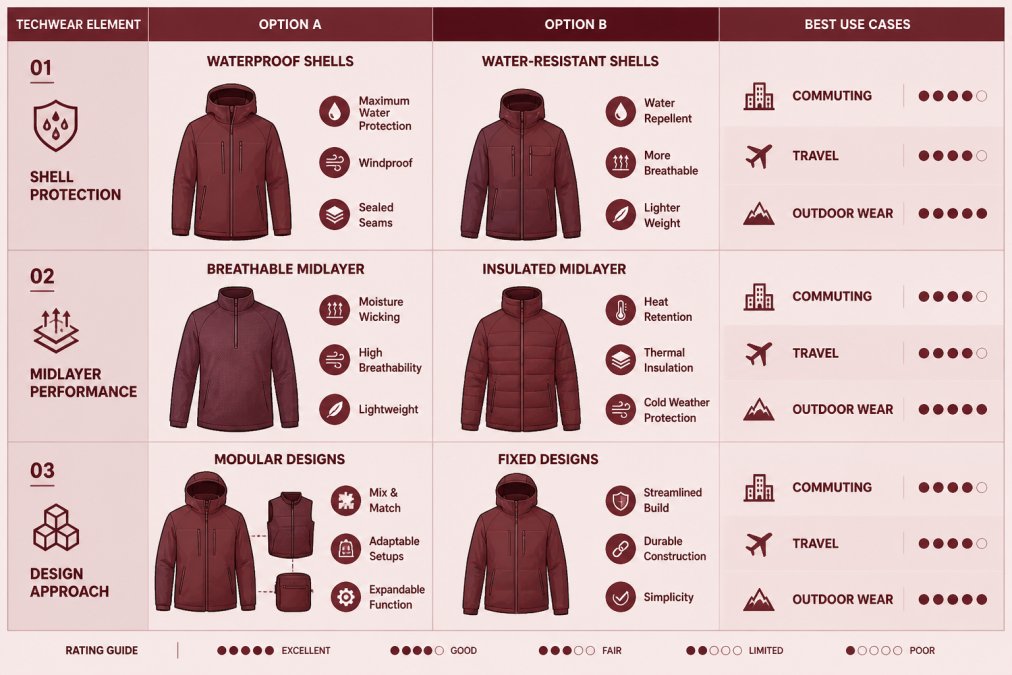
Fabric choice decides whether a garment performs or just looks the part. Synthetics dominate because they hold shape, resist water, and can be engineered for breathability.
Look for these material types:
- Ripstop nylon. Lightweight, tear-resistant, and commonly used in shells and pants.
- Polyester blends. Durable, quick-drying, and the base for most 3D-printed and sublimated graphic pieces.
- Softshell and bonded fabrics. Combine water resistance with stretch for movement.
- Mesh and perforated panels. Added at high-heat zones for ventilation.
"High-tech" is often just a marketing label, a water-resistant garment may only shed light rain. Check the construction: taped seams, coated zippers, and laminated layers signal real performance.
Layering Techniques for Sci-Fi Looks
Layering is where futuristic men's clothing either works or collapses. The goal is depth without bulk, so each layer must be thinner than in a traditional winter stack.
A reliable three-layer system:
- Base layer. A fitted tee or long-sleeve in a technical knit. The Neon Cityscape Graphic Tee works here because its lightweight build sits flat under outerwear while adding graphic interest when worn alone.
- Mid layer. A hoodie or sweatshirt, ideally with a structured hood. The Mens 3D Print Hooded Sweatshirt uses a loose fit that drapes well over a base layer without bunching.
- Outer layer. A shell, jacket, or overshirt with visible hardware. This is where the silhouette gets defined.
Industrial Fashion: Utilitarian Style for the Modern Man
Industrial fashion rebuilds workwear utility with modern materials and sharper proportions. Where techwear leans sci-fi, industrial fashion leans toward cargo pockets, reinforced stitching, and a grounded, urban feel.

Both value durability, function, and a muted palette. The difference is styling, industrial fashion pairs with boots and denim, while techwear pushes into synthetics and modular accessories.
For everyday wear, start with one industrial anchor piece, a cargo pant or utility jacket, and build around neutral basics. This keeps the look intentional rather than themed.
How to Style Futuristic Men's Clothing for Everyday Wear
Everyday styling comes down to restraint.
Start with the universal rules, then adjust for your frame.
- Pick one focal point. A graphic tee, a technical jacket, or a hardware-heavy pant. Not all three.
- Keep the rest minimal. Plain black or charcoal basics let the focal piece read clearly.
- Match your footwear to the silhouette. Slim technical sneakers for tapered pants, chunkier boots for wide-leg cargo.
- Limit accents. One metallic or neon detail per outfit is usually enough.
Styling by Body Type
Tall and lean frames. You have the most room to run oversized. A longline shell hitting mid-thigh with wide-leg cargo pants creates the draped, sci-fi column silhouette. Avoid cropped jackets above the hip, they break the vertical line.
Broad or muscular frames. Boxy cuts work in your favor, but volume on volume reads as bulky. Anchor with a structured outer layer, a bonded softshell or utility jacket with defined shoulders, and keep the mid layer slim. Tapered or straight-leg technical pants balance a heavy upper body better than wide-leg cuts.
Shorter frames. The goal is an unbroken vertical line. Wear monochrome shoulder to shoe, black on black, charcoal on charcoal, and let hardware and fabric texture carry the interest instead of color blocking. A cropped or hip-length jacket with high-rise tapered pants lengthens the leg; slim technical sneakers beat chunky boots.
Stocky or heavier builds. Structured fabrics are your ally: ripstop nylon, bonded softshell, and coated cotton hold shape and skim the body rather than clinging. Avoid thin, clingy knits and shiny fabrics. Dark, matte monochrome with one vertical detail, a center zipper, a single strap, draws the eye up and down rather than across.
Proportion Rules That Apply to Everyone
- The third-piece rule. A base layer, a mid layer, and an outer layer is the maximum before an outfit reads as cluttered. If you add a fourth piece, remove one.
- Break the line once. One horizontal element per outfit, a belt, a hem, a strap, is enough. Two or more chop the silhouette into segments.
- Match volume to volume. A voluminous top wants a slimmer bottom, and vice versa. Volume on both ends reads as shapeless.
- Let the hem fall where it flatters. Jacket hems at the hip or mid-thigh; pant hems at the ankle or just below. Anything in between shortens the leg.
For a coordinated option, the Mens Zip-Up Jacket and Pants Set delivers a matched digital-print look that removes the guesswork, ideal for events, travel, and any setting where a unified silhouette matters more than mixing pieces. Because the set is cut as a unit, the proportion is already resolved; you only need to size it to your frame.
STAY LOCKED IN WITH PLANET iZM →

The goal is proportion, not a fixed rule. The same jacket that flatters a tall frame can be tailored for a shorter one with a simple hem adjustment.
Choosing the Right Sci-Fi Streetwear Brands
Sci-fi streetwear brands vary widely in quality, and price doesn't always reflect construction. The category attracts serious technical designers and labels that simply print a futuristic graphic on a standard blank.
What to Inspect Before You Buy
Fabric weight and hand-feel. A technical shell should feel substantial without stiffness. Ripstop nylon in the 40D to 70D range is the sweet spot for jackets, light enough to layer, dense enough to resist abrasion (textileworld.com). If a product page lists no denier, GSM, or material composition, the brand is selling a look, not a garment.
Seam construction. Turn the piece inside out. Taped or welded seams mean the manufacturer invested in waterproofing; overlocked (serged) seams are fine for non-waterproof pieces. Single-stitched seams on stress points, shoulders, armholes, crotch, are a failure waiting to happen.
Hardware quality. Zippers should be metal or high-quality molded plastic from a known maker; Buckles should be acetal or metal, not thin plastic that flexes under thumb pressure. D-rings should be welded, not split.
Fit consistency. Sizing varies wildly across brands, a medium from one label can fit like a large from another. Before ordering, check whether the brand publishes a size chart with actual garment measurements (chest, shoulder, sleeve, length), not just body measurements. If they only list S/M/L with no numbers, expect to guess.
Evaluation Checklist
| What to Check | Why It Matters | Red Flag |
|---|---|---|
| Fabric specification | Determines performance and lifespan | No material, denier, or GSM listed |
| Seam construction | Waterproofing and durability | Single-stitched stress points |
| Hardware quality | Buckles and zippers fail first | Unbranded plastic buckles on premium pricing |
| Fit consistency | Sizing varies wildly across brands | No garment measurements in size chart |
| Return policy | Fit and feel can't be judged online | Restocking fees or short windows |
Matching the Brand to Your Use Case
Not every buyer needs the same thing: a commuter walking ten minutes in light rain has different requirements than someone building a costume-adjacent look for events.
- For daily wear and commuting: Prioritize breathability and packability over maximum waterproofing. A softshell with a DWR (durable water repellent) finish handles most urban conditions and breathes better than a fully taped hardshell (rei.com).
- For travel: Look for pieces that pack flat, resist wrinkles, and have secure pockets. Modular designs with removable straps and pouches adapt to different settings.
- For events and photos: Fabric performance matters less than silhouette and print quality. A sublimated graphic on a polyester blend will hold color better than a screen print on cotton.
- For outdoor use: Demand taped seams, coated zippers, and a published waterproof rating. If the brand won't state a hydrostatic head rating, assume it isn't waterproof.
Planet iZM sits in this space as a lifestyle brand rather than a pure technical outfitter. The catalog pairs sci-fi themed apparel with home goods and the iZM Genetics wellness line, so the brand is built around a broader aesthetic than clothing alone. If you want a single source for apparel, accessories, and self-care products sharing one visual identity, that consolidation is the main draw.
The Maintenance Question
Sustainable and DIY Futuristic Gear
Sustainability rarely gets mentioned in futuristic fashion coverage. Synthetic fabrics are durable by nature, and that durability is itself a sustainability argument: a jacket that lasts eight years replaces several cheaper ones.
Practical ways to reduce the footprint of a futuristic wardrobe:
- Repair before replacing. Replacing a zipper or re-stitching a seam costs far less than a new jacket.
- Buy fewer, better pieces.
- Upcycle graphic tees. A faded print can be overdyed or layered under a mesh top for a new look.
- Resell or swap. Technical pieces hold value well when the hardware is intact.
DIY upcycling works best on graphic pieces rather than structural outerwear. Adding patches, straps, or hardware to a plain hoodie pushes a basic piece toward the aesthetic without a full redesign.
Caring for Your High-Tech Wardrobe
Technical fabrics fail from improper washing more often than from wear. The coatings and laminations that make a garment water-resistant degrade quickly under heat and harsh detergent.
Follow these rules:
- Wash cold, on a gentle cycle. Heat breaks down coatings and shrinks synthetic blends.
- Skip fabric softener. It coats fibers and blocks breathability (cleaninginstitute.org).
- Close all zippers and buckles before washing to prevent snags.
- Air dry whenever possible. If you must use a dryer, keep it on low.
- Reapply water repellency with a spray-on treatment when you notice water no longer beads.
Store outerwear on wide hangers rather than folded, and keep hardware from pressing into fabric for long periods. These habits extend a technical piece's life considerably.
Conclusion
Building a futuristic wardrobe involves careful consideration of construction and styling. Pieces with quality construction tend to last, and outfits built with restraint often achieve a cohesive look.
Planet iZM curates sci-fi themed streetwear alongside lifestyle and wellness products, so you can build a consistent aesthetic from a single source. The catalog includes graphic tees, 3D-printed hoodies, and coordinated jacket-and-pants sets, plus the iZM Genetics skincare line for self-care. Get started with Planet iZM and build a wardrobe that holds up as well as it looks.
Frequently Asked Questions
What defines futuristic men's clothing?
Futuristic men's clothing combines function with a forward-thinking aesthetic. It features technical fabrics like waterproof and breathable synthetics, asymmetric or geometric cuts, and modular details such as straps, buckles, and detachable pockets. The style often draws from cyberpunk, dystopian, and sci-fi themes, creating a bold, urban silhouette that feels both innovative and practical for modern wear.
Is techwear the same as futuristic fashion?
Techwear is a subset of futuristic fashion focused on performance and utility. While all techwear is futuristic, not all futuristic clothing is techwear. A metallic bomber jacket or an oversized graphic tee can be futuristic without being techwear. The techwear aesthetic specifically prioritizes high-tech fabrics, modular gear, and functional design for urban environments, whereas futuristic fashion includes a wider range of avant-garde and sci-fi-inspired styles.
How can I incorporate futuristic elements into my current wardrobe?
Start with one statement piece, like a neon cityscape graphic tee or a 3D-printed hoodie, and pair it with your existing jeans and sneakers. Add a tactical accessory such as a crossbody strap or a minimalist metallic watch. As you get comfortable, introduce layered pieces like an asymmetric zip-up jacket. This gradual approach lets you build a sci-fi streetwear look without replacing your entire closet.
What materials are commonly used in futuristic clothing?
Futuristic clothing often uses synthetic textiles like polyester, nylon, and spandex blends for durability, stretch, and weather resistance. High-tech fabrics may include waterproof membranes, breathable mesh panels, and reflective or metallic coatings. These materials support the functional and aesthetic goals of the style, offering performance features like moisture-wicking and wind protection while creating the sleek, industrial look associated with sci-fi streetwear.